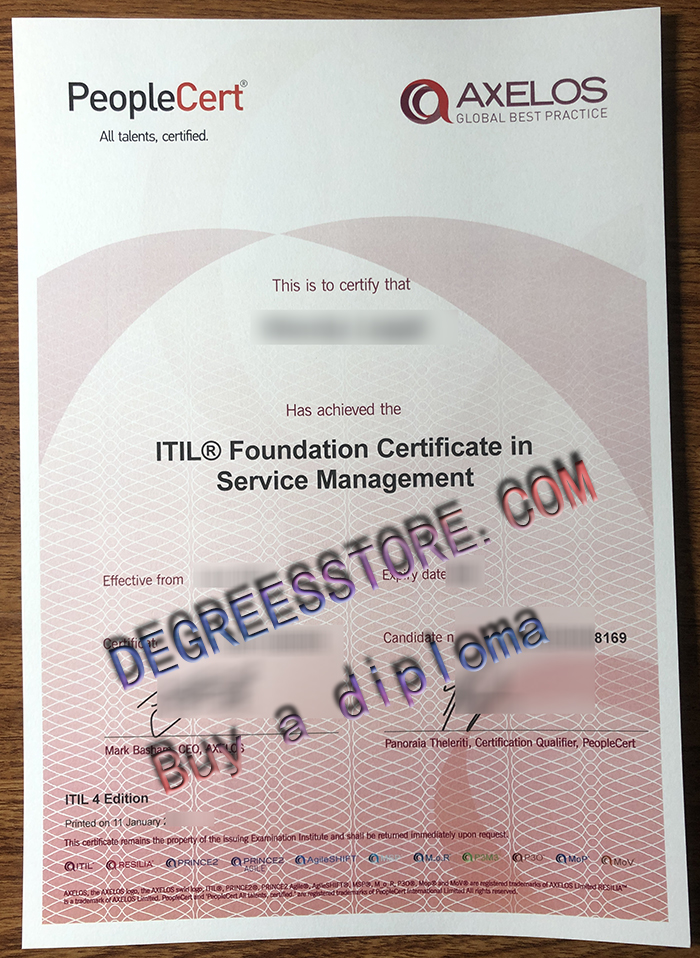
ITIL® 4 Foundation, as an authoritative entry-level certification for IT Service Management (ITSM), revolves around the core principles of “value-driven, agile adaptation, and end-to-end collaboration.” Buy a ITIL®4 Foundation certificate. It constructs a complete knowledge framework adapted to digital transformation, with its core modules broken down into five core sections covering theoretical foundations, practical methods, and application logic:
I. Core Concept: From “Process-Oriented” to “Value-Oriented”
The most fundamental upgrade in ITIL® 4 is abandoning the traditional process-centric limitations of ITIL and shifting to a “value-creation-centric” mindset. It emphasizes that IT services are no longer isolated technical support, but rather value carriers deeply integrated with business objectives—by understanding customer needs and optimizing service chains, IT resources are transformed into tangible value such as business growth and efficiency improvements. This concept permeates all knowledge modules and serves as the logical starting point for subsequent frameworks and practices.
II. Core Framework: Service Value System (SVS) The Service Value System is the “core engine” of ITIL® 4, clearly defining the entire process of IT services from demand generation to value delivery. It comprises five key components:
Guiding Principles: Seven universal principles (Focus on Value, Start with the Status Quo, Iterate Incrementally, Collaborate for Improvement, View the Whole, Keep It Simple, and Be Feedback-Based) provide a unified standard of action for all service management activities. For example, “Focus on Value” requires all IT work to align with business objectives and avoid ineffective processes.
Governance: Clearly define decision-making mechanisms, responsibilities, and compliance requirements to ensure that service management activities align with organizational strategy and balance risks and benefits.
Service Value Chain (SVC): Six interrelated activities (Planning & Design, Development & Deployment, Delivery & Support, Improvement, etc.) constitute the core process of value creation, supporting flexible combinations to form different value streams (such as fault response streams and new service launch streams). Buy a certificate.
Practices: 18 fundamental management practices (including general practices such as continuous improvement and information security management; service management practices such as service level management and issue management; and technology management practices such as infrastructure and platform management) provide concrete tools and methods for implementing the service value chain.
How to make a ITIL®4 Foundation certificate online?
Continuous Improvement: A closed-loop mechanism throughout the entire process, using a “Plan-Do-Check-Act” cycle to continuously optimize service quality, process efficiency, and value output.
III. Four Dimensions: Ensuring the Comprehensiveness and Balance of Service Management
ITIL® 4 proposes four dimensions covering key elements of service management, avoiding the one-sidedness of a single dimension:
Organization and People: Focusing on role definition, responsibility division, team collaboration, and skills development, emphasizing that “people” are the core of value creation. For example, clarifying the collaboration logic of roles such as IT help desk, technical support, and business liaison.
Information and Technology: Covering technical tools, data resources, and knowledge management that support services, such as the application of ITSM tools, the collection and analysis of service data, and the construction of knowledge bases.
Partners and Suppliers: Focus on the collaborative management of external resources, including supplier selection, contract management, and optimization of collaboration processes, such as collaboration standards with cloud service providers and hardware/software vendors.
Value Stream and Processes: Optimize end-to-end service delivery processes, eliminate departmental barriers, and ensure an efficient and smooth value stream, such as simplifying the entire process from user request submission to problem resolution.
IV. Core Management Practices: Key Tools for Realizing Value
ITIL®4 Foundation focuses on the fundamental content of 18 core practices, emphasizing the goals, application scenarios, and key activities of these practices. High-frequency test points include:
General Practices: Continuous Improvement (Closed-Loop Optimization Methodology), Information Security Management (Core Risk Control), Relationship Management (Customer and Partner Collaboration);
Service Management Practices: Service Level Management (Clearly Defined Service Quality Standards and Commitments), Problem Management (Root Cause Analysis and Prevention), Incident Management (Rapid Response and Service Recovery), Change Control (Balancing Innovation and Risk);
Technology Management Practices: Infrastructure and Platform Management (Basic IT Resource Operations), Deployment Management (Smooth Deployment of New Services/Updates).
V. Compatibility and Adaptation: Integrating Mainstream Industry Practices
ITIL® 4 Foundation is not an isolated system, but deeply compatible with mainstream practices such as Lean, Agile, and DevOps. For example:
It incorporates Agile’s concepts of “iterative delivery” and “customer feedback” to support rapid response to business changes;
It integrates DevOps’ “development and operations collaboration” mindset to break down technical team barriers;
It draws on Lean’s methods of “eliminating waste” and “value stream optimization” to improve service efficiency.
These core concepts are progressively structured, building a systematic theoretical framework while providing actionable practical logic. This helps learners understand the essence of IT service management—achieving deep integration of IT and business through scientific methods to create sustainable value for the organization.
Download For Windows
 Degree-Cert Form
Download For Mac OS X
 Degree-Cert Form